Tomorrow's Tourism: A Perspective on AI, Robots, and the Industry's Next Century
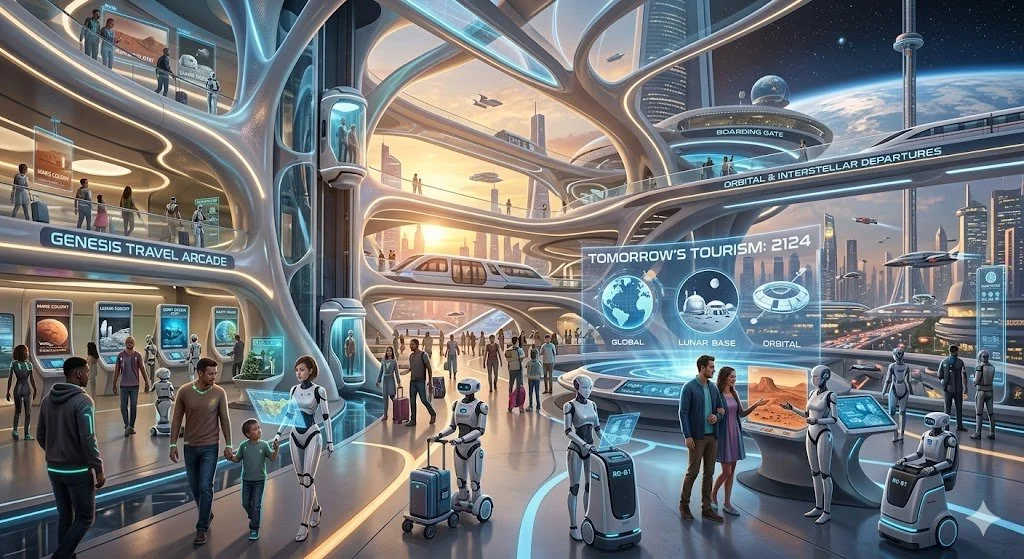
The most important thing to understand about tourism's future is that technology is not the story. The story is what happens to “desire” when friction disappears.
The near-term shift (now–2040) is already underway. AI doesn't replace the travel experience, it removes the administrative noise around it. Itinerary friction, language barriers, visa bureaucracy, crowd bottlenecks, all gradually absorbed into invisible intelligent systems. The traveler gains time and attention back, but the destination remains fundamentally what it always was: a place to be moved by something beyond the ordinary.
The automation decade (2040–2060) is where robotics becomes genuinely disruptive. Not in a dystopian sense, but structurally. The human labor that currently delivers hospitality (concierges, drivers, guides, front desk staff ) migrates toward curation, emotional intelligence, and cultural interpretation. Machines execute; humans mean things. This is a profound reorientation for tourism economies where the workforce composition of the hospitality sector will require deliberate policy foresight.
The immersion era (2060–2080) raises the field's most philosophically interesting question: when you can experience Petra at its Nabataean peak through a neural-linked interface, why travel physically? The answer, historically, has always been the body in place… the heat, the scale, the contingency. If technology can replicate that convincingly, then physical tourism either becomes ultra-luxury or it becomes cultural resistance.
By 2100–2125, I'd argue the central paradox crystallizes: the more perfect AI makes the journey, the more valuable imperfection becomes. This isn't speculative, we see it already in analog photography, artisanal food, slow travel movements. At the far edge of a century of AI optimization, the premium experience is likely to be the handcrafted, the inefficient, the stubbornly human, the guide who gets the story slightly wrong, the hotel with no smart features, the itinerary nobody designed.
For tourism policymakers and destination strategists, the implication is clear: the race is not to automate fastest, but to preserve what cannot be automated (authenticity, cultural density, genuine human encounter) as the irreplaceable core that smart technology should serve, not replace.
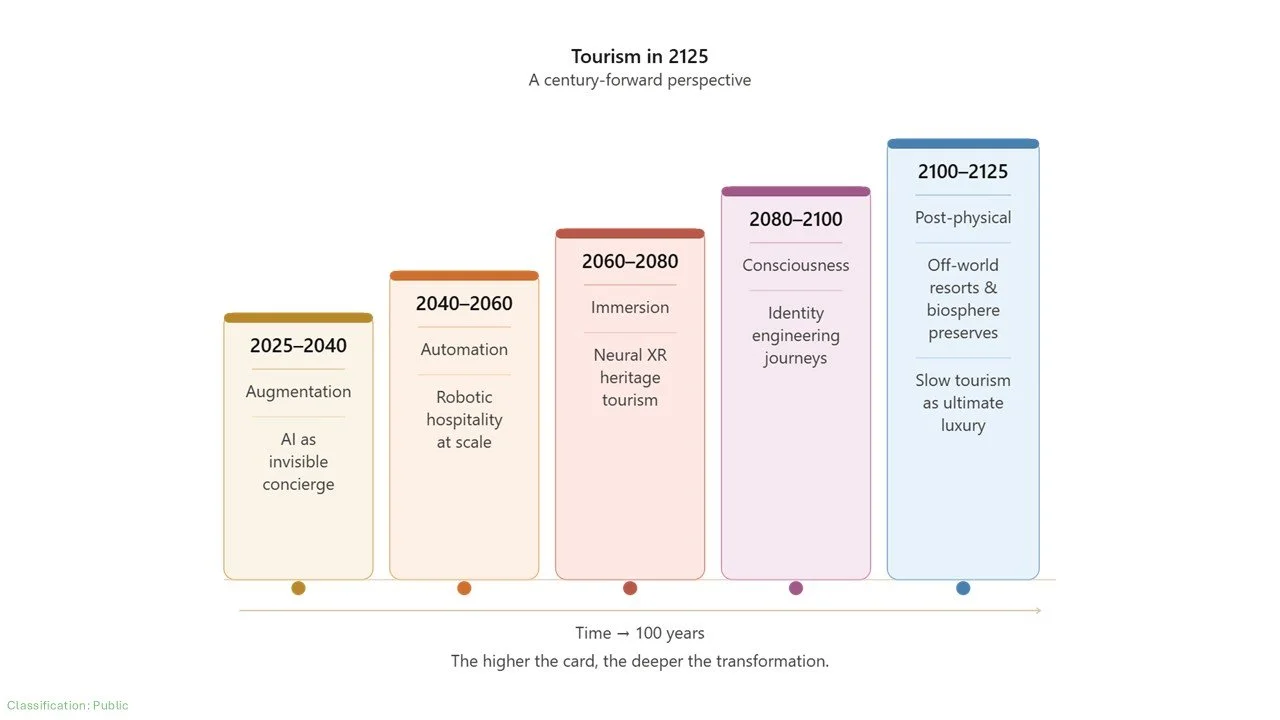
Tourism in 2125 Perspective Model